Feature list
Every feature column produced by feature computation, grouped by the family that emits it. The columns and units below are those declared by the pandera schemas in ephysatlas.features, which are what the code validates against.
Columns marked * are optional or nullable: they are absent from older vintages, or only produced when a specific option is enabled. Everything else is always present when its family is computed.
Families
| family | band | schema | needs |
|---|---|---|---|
lf |
LF | ModelLfFeatures |
lite install |
csd |
LF | ModelCsdFeatures |
lite install |
ap |
AP | ModelApFeatures |
lite install |
waveforms |
AP | ModelSpikeFeatures |
[full] extra (DARTsort) |
ModelRawFeatures is the union of all four plus ModelChannelLayout (56 columns), and is the schema a complete raw feature table validates against. ModelDenoisedFeatures (54 columns) is the same with the spike block swapped for the spike-shape columns; a denoised table written since ephysatlas 0.9.0 validates against it (tables before 2026_W42 once their *_csd_diff1 columns are renamed, as read_features_from_disk does).
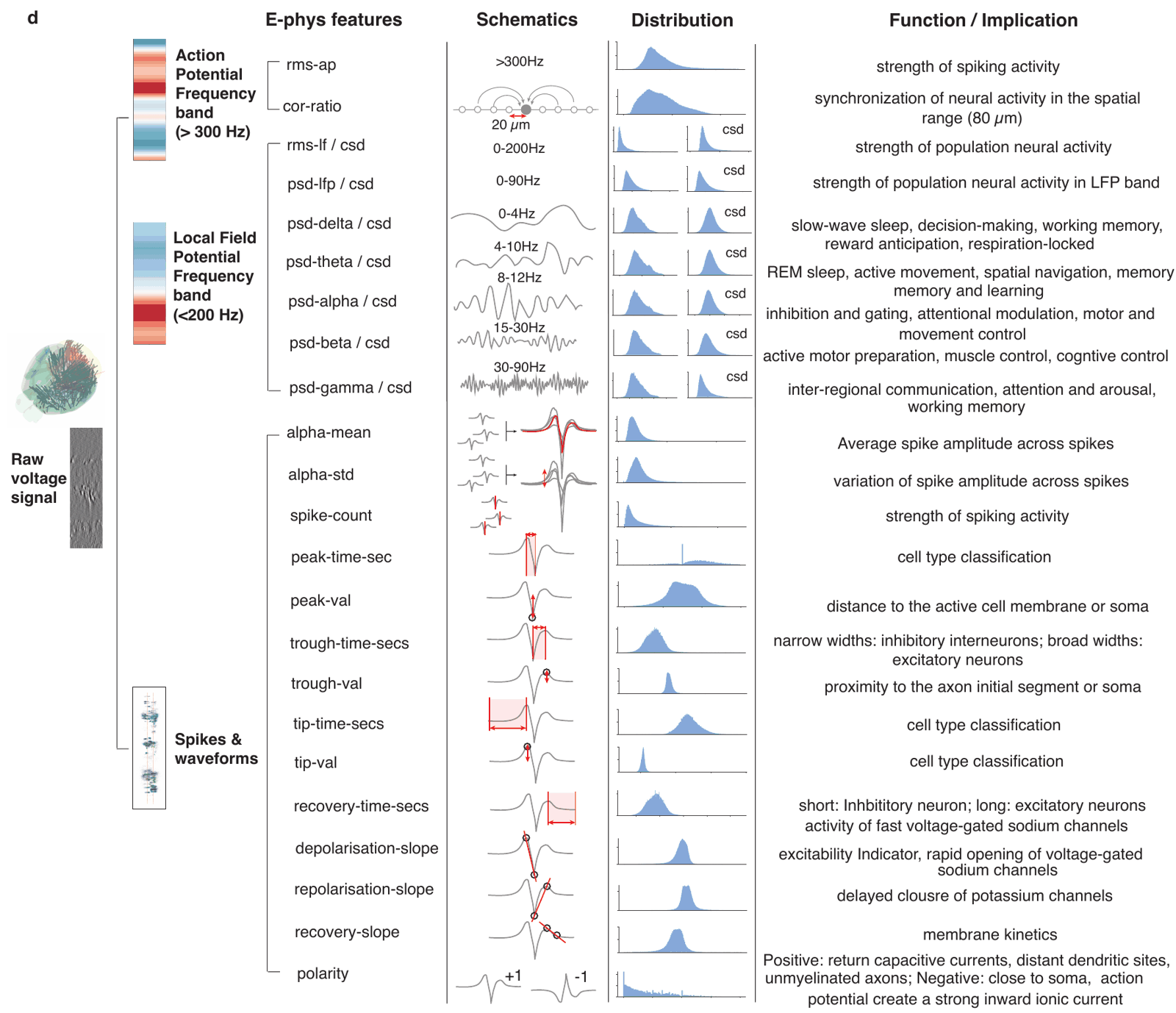
peak-val, trough-val, … are the landmark columns that the denoised table now remaps).Frequency bands
Every psd_* column integrates power over one of these bands, defined in ephysatlas.features.BANDS:
| band | range (Hz) |
|---|---|
delta |
0 – 4 |
theta |
4 – 10 |
alpha |
8 – 12 |
beta |
15 – 30 |
gamma |
30 – 90 |
lfp |
0 – 90 |
alpha overlaps both theta and beta, and lfp spans the whole range — the bands are not a partition, so the psd_* columns are not independent and do not sum to psd_lfp.
Raw versus denoised units
Three features are transformed by denoising and returned in the transformed unit:
| column | raw unit | denoised unit | transform |
|---|---|---|---|
rms_lf |
V | dB rel. V | 20 · log10(x) |
rms_ap |
V | dB rel. V | 20 · log10(x) |
spike_count |
count/s | log2 (count/s) | log2(x), with 0 → NaN |
So raw_ephys_features.pqt has rms_lf around 1e-5 while raw_ephys_features_denoised.pqt has it around −90. The unit column in the tables below gives the denoised unit where a transform exists. A model trained on denoised features expects the denoised unit — see aggregate and denoise.
lf — ModelLfFeatures (19 columns)
| column | unit | description |
|---|---|---|
rms_lf |
dB rel. V | Root mean square of the LFP signal |
psd_lfp |
dB rel. V²/Hz | Power in the band 0 – 90 Hz |
psd_delta |
dB rel. V²/Hz | Power in the band 0 – 4 Hz |
psd_theta |
dB rel. V²/Hz | Power in the band 4 – 10 Hz |
psd_alpha |
dB rel. V²/Hz | Power in the band 8 – 12 Hz |
psd_beta |
dB rel. V²/Hz | Power in the band 15 – 30 Hz |
psd_gamma |
dB rel. V²/Hz | Power in the band 30 – 90 Hz |
psd_residual_lfp * |
dB rel. V²/Hz | Power in 0 – 90 Hz after removing the linear fit of the PSD decay in log-log space |
psd_residual_delta * |
dB rel. V²/Hz | Power in 0 – 4 Hz after removing the PSD-decay fit |
psd_residual_theta * |
dB rel. V²/Hz | Power in 4 – 10 Hz after removing the PSD-decay fit |
psd_residual_alpha * |
dB rel. V²/Hz | Power in 8 – 12 Hz after removing the PSD-decay fit |
psd_residual_beta * |
dB rel. V²/Hz | Power in 15 – 30 Hz after removing the PSD-decay fit |
psd_residual_gamma * |
dB rel. V²/Hz | Power in 30 – 90 Hz after removing the PSD-decay fit |
aperiodic_offset * |
dB rel. V²/Hz | Y-intercept of the PSD-decay fit in log-log space |
aperiodic_exponent * |
dB rel. V²/Hz | Slope of the PSD-decay fit in log-log space |
decay_fit_error * |
dB rel. V²/Hz | RMS error of the PSD-decay fit |
decay_fit_r_squared * |
dimensionless | R² of the PSD-decay fit |
decay_n_peaks * |
count | Number of peaks detected in the residual after removing the PSD-decay fit |
rms_lf_no_car * |
dB rel. V | LFP RMS destriped without common-average referencing. Opt in via LfParams(compute_rms_no_car=True) |
The psd_residual_*, aperiodic_* and decay_* columns are the spectral parameterisation features, computed with specparam and introduced in vintage 2025_W39. They are controlled by LfParams(decay_features=True), on by default. Vintages before 2025_W39 lack them entirely — which matters, because every published region decoder requires them.
csd — ModelCsdFeatures (14 columns)
The same measures computed on spatial differences of the LFP rather than the raw LFP: the *_csd columns on the second difference (the current-source density proper) and the *_bpr columns on the first difference between consecutive contacts of a column (bipolar referencing). Both are Cadzow-denoised first and scaled by the tissue conductivity and the intercontact distance, so their units are A/m³ and A/m². With CsdParams(scale=False) they are raw differences in V and these units do not apply.
| column | unit | description |
|---|---|---|
rms_lf_csd |
dB rel. A/m³ | Root mean square of the CSD signal |
psd_delta_csd |
dB rel. (A/m³)²/Hz | CSD power in 0 – 4 Hz |
psd_theta_csd |
dB rel. (A/m³)²/Hz | CSD power in 4 – 10 Hz |
psd_alpha_csd |
dB rel. (A/m³)²/Hz | CSD power in 8 – 12 Hz |
psd_beta_csd |
dB rel. (A/m³)²/Hz | CSD power in 15 – 30 Hz |
psd_gamma_csd |
dB rel. (A/m³)²/Hz | CSD power in 30 – 90 Hz |
psd_lfp_csd |
dB rel. (A/m³)²/Hz | CSD power in 0 – 90 Hz |
rms_lf_bpr * |
dB rel. A/m² | Root mean square of the bipolar-referenced (BPR) signal |
psd_delta_bpr * |
dB rel. (A/m²)²/Hz | BPR power in 0 – 4 Hz |
psd_theta_bpr * |
dB rel. (A/m²)²/Hz | BPR power in 4 – 10 Hz |
psd_alpha_bpr * |
dB rel. (A/m²)²/Hz | BPR power in 8 – 12 Hz |
psd_beta_bpr * |
dB rel. (A/m²)²/Hz | BPR power in 15 – 30 Hz |
psd_gamma_bpr * |
dB rel. (A/m²)²/Hz | BPR power in 30 – 90 Hz |
psd_lfp_bpr * |
dB rel. (A/m²)²/Hz | BPR power in 0 – 90 Hz |
The *_bpr columns were called *_csd_diff1 before vintage 2026_W42. ephysatlas.data.read_features_from_disk renames them when it reads an older table (data.LEGACY_FEATURE_RENAMES).
ap — ModelApFeatures (3 columns)
| column | unit | description |
|---|---|---|
rms_ap |
dB rel. V | Root mean square of the AP signal |
cor_ratio |
dimensionless | Median zero-lag cross-correlation with neighbouring channels, over the zero-lag autocorrelation |
channel_labels |
code | Channel quality label — see below |
channel_labels is a small integer code, not a measurement:
| value | meaning |
|---|---|
0 |
Good channel |
1 |
Dead — low coherence or amplitude |
2 |
Noisy |
3 |
Outside the brain |
Anything greater than 0 is a bad channel. read_features_from_disk derives a boolean outside column from channel_labels == 3, and the region decoder consumes both.
waveforms — ModelSpikeFeatures (18 columns)
Requires the [full] extra. Twelve columns are shared with the spike-shape schema (they live on ModelSpikeSharedFeatures):
| column | unit | description |
|---|---|---|
spike_count |
log2 (count/s) | Mean spike rate across snippets (nulls counted as 0), log2-transformed |
alpha_mean |
native | Mean spike “brightness”, from the spike-localisation step |
alpha_std |
native | Standard deviation of the spike brightness |
polarity |
dimensionless | Sum of per-spike polarities divided by the number of spikes |
tip_val |
V | Waveform tip amplitude |
depolarisation_slope |
V/s | Slope of the line crossing the tip and peak points |
repolarisation_slope |
V/s | Slope of the line crossing the peak and trough points |
recovery_slope |
V/s | Slope of the line crossing the trough and recovery points |
spatial_spread_um * |
µm | Amplitude-weighted mean distance of the multi-channel waveform’s neighbour channels from the peak channel |
spatial_spread_um_std * |
µm | Its standard deviation across the channel’s spikes |
slowness_s_per_m * |
s/m | Signed slowness (inverse apparent velocity) of the waveform along the probe axis |
slowness_s_per_m_std * |
s/m | Its standard deviation across the channel’s spikes |
and six are the raw waveform landmarks, relative to the extracted waveform window:
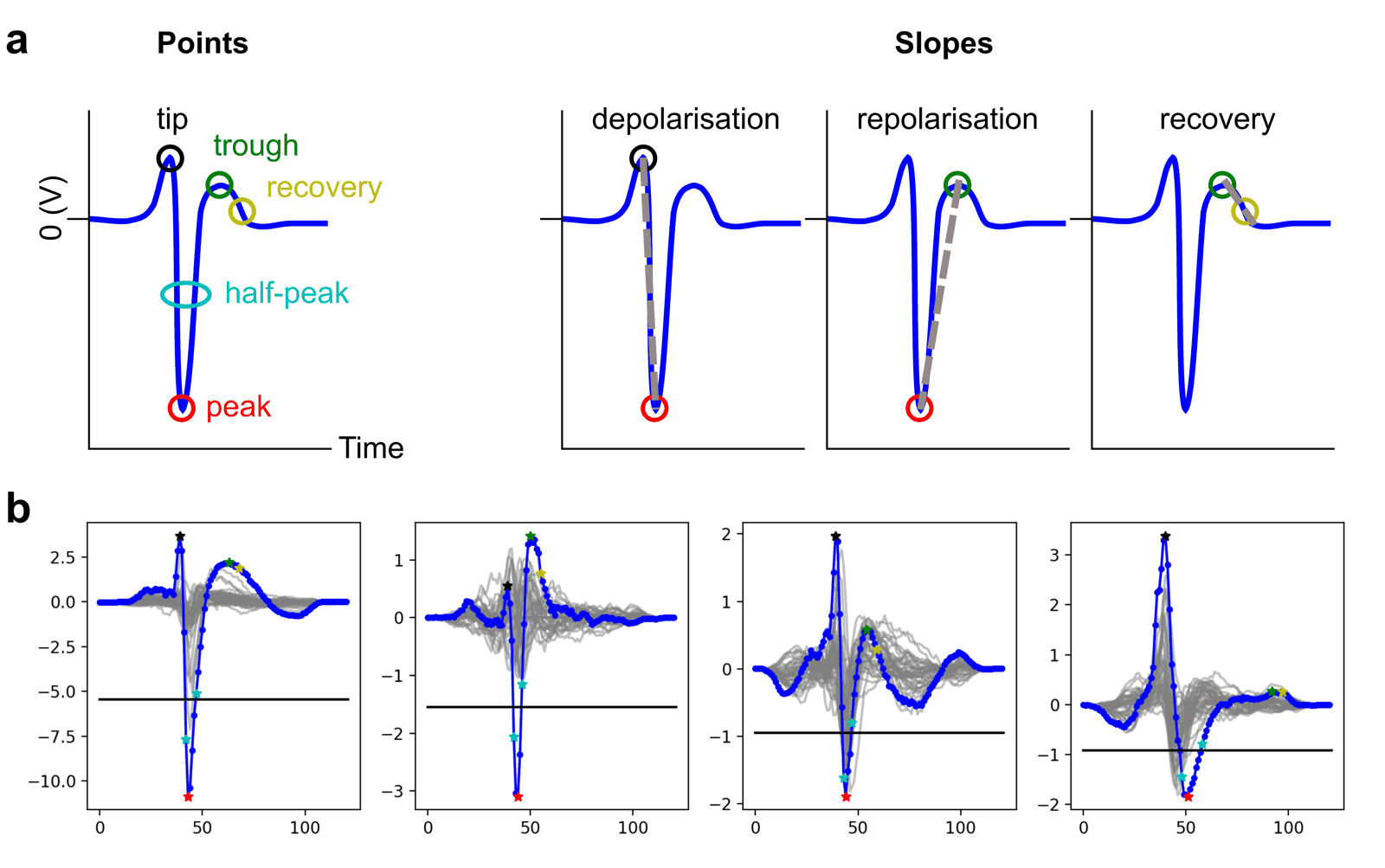
| column | unit | description |
|---|---|---|
peak_time_secs |
s | Time to the waveform peak |
peak_val |
V | Peak amplitude |
trough_time_secs |
s | Time to the waveform trough |
trough_val |
V | Trough amplitude |
tip_time_secs |
s | Time to the waveform tip |
recovery_time_secs |
s | Recovery time |
The four spread and slowness columns are nullable: NaN wherever too few neighbour channels have a usable value, and the _std columns are NaN on a channel with fewer than two qualifying spikes (sample standard deviation). alpha_mean / alpha_std stay in DARTsort’s native localisation units.
The six landmark columns carry no description in the pandera schema itself, and the four timing ones no unit — the descriptions above come from the ModelSpikeFeatures class docstring. Read ephysatlas.features.spikes if you need the exact definition.
Waveform geometry is 121 samples with the trough at sample 42. Two boundaries make waveform features incomparable across them:
- 0.7.0, the DARTsort 0.5 migration: detections rose about 9.5 % and amplitudes came out about 10 % smaller.
- 0.9.0: amplitudes are in volts. Before, they were in DARTsort’s per-channel RMS units (amplitudes and slopes alike), and
spike_countwas a per-snippet count rather than a rate. Tables from2026_W39on use the new units.
Spike-shape columns — ModelSpikeShapeFeatures (16 columns)
The denoised tables replace the six landmark columns with four interpretable ones, computed from them (aggregation.apply_waveform_remap); the twelve shared columns pass through:
| column | unit | description |
|---|---|---|
spike_width_secs |
s | Trough-to-peak duration: trough_time_secs − peak_time_secs |
predepolarisation_width_secs |
s | Tip-to-peak duration: peak_time_secs − tip_time_secs |
spike_amplitude |
V | Overall amplitude: trough_val − peak_val |
peak_to_trough_ratio_log |
dimensionless | log(|peak_val / trough_val|): shape asymmetry, independent of amplitude |
The raw tables (raw_ephys_features.pqt) keep the landmark columns. remap_waveform_shape_features applies the same transform to a table you hold, and remap_waveform_shape_features_volume to an encoding volume.
Channel metadata — ModelChannelLayout
Always present, from the recording geometry rather than a feature family.
| column | unit | description |
|---|---|---|
axial_um |
µm | Distance along the probe length (depth) |
lateral_um |
µm | Distance across the probe width |
The full channels.pqt table, as published in ea_active/2026_W42 (402,816 channels across 1,049 probes):
| column | unit | description |
|---|---|---|
pid |
— | Probe insertion id (index level 0) |
channel |
index | Channel index (index level 1) |
x, y, z |
m | Resolved histology coordinates from Bregma — metres, see below |
x_target, y_target, z_target |
m | Target coordinates from the best Alyx trajectory — metres, see below |
axial_um |
µm | Distance along the probe length (depth). Observed 20 – 3840 |
lateral_um |
µm | Distance across the probe width. Observed 11 – 59 |
acronym |
— | Brain region acronym, Allen mapping |
atlas_id |
— | Allen structure id |
labels |
code | Channel quality label. ~34 % null in 2026_W42 |
rawInd |
index | Original channel index from the source. Descriptive only |
shank |
index | Shank number |
probe_model |
— | Probe part number from SpikeGLX (imDatPrb_pn), e.g. PRB_1_4_0480_1 |
referencing_scheme |
— | external, tip, ground or on_shank, from SpikeGLX imroTbl |
In 2026_W39 and 2026_W42 every column except labels is fully populated. Older vintages are sparser: in 2026_W37, labels was ~99 % null, rawInd / shank / probe_model / referencing_scheme ~94 % (populated only where SpikeGLX metadata was available at aggregation time), and the *_target columns ~50 %.
distance_to_tip_um is declared Optional in ChannelDataFrameSchema but is not present in any current ea_active vintage.
Coordinates are in metres. Probe geometry is in micrometres.
| columns | unit |
|---|---|
x, y, z, x_target, y_target, z_target |
metres (from Bregma, IBL convention) |
axial_um, lateral_um, distance_to_tip_um |
micrometres |
Practical consequence: the plotting functions want the µm pair (lateral_um, axial_um), while the spatial encoder wants the metre triple. Passing µm to the encoder places every channel outside the brain and returns meaningless predictions with no error.
Verified against ea_active/2026_W37: reprojecting x/y/z through AllenAtlas.get_labels — a metres API — reproduces the table’s own acronym column for 100% of a 4,000-channel random sample; reading the same values as micrometres reproduces 2.7%. The observed range, ±0.008, is a mouse brain in metres.
ChannelDataFrameSchema, ModelHistologyResolved and ModelHistologyPlanned declared raw_unit: "um" for all six coordinate columns before 0.9.0. That was wrong and is corrected. All six also name the coordinate space in their description. Planned and resolved coordinates share a frame and differ only by insertion error.
The *_target columns come from feature_computation.add_target_coordinates. It queries Alyx trajectories up to provenance 50 and takes the best one the insertion has, in the order of feature_computation.PROVENANCE_PREFERENCE:
Micro-manipulator(provenance 30)- else
Planned(10) - else
Histology track(50)
A micro-manipulator or planned trajectory is converted from the needles (in-vivo) atlas into Allen space, with the 5° pitch correction. A histology track is already in Allen space and is used as is. An insertion with none of the three raises ValueError.
Programmatic access
Do not hardcode a feature list — derive it:
import ephysatlas.features

# All feature columns, by provenance
print(ephysatlas.features.voltage_features_set())

# The frequency bands
print(ephysatlas.features.BANDS)

# Column names, dtypes, descriptions and units straight from the schema
schema = ephysatlas.features.ModelRawFeatures.to_schema()
for name, col in schema.columns.items():
    print(name, col.dtype, col.description, (col.metadata or {}).get("raw_unit"))
And when a model is involved, the model’s own manifest is authoritative:
from ephysatlas import load_pretrained

model = load_pretrained(
    "int-brain-lab/ea-decoder-channel-xgboost", revision="2026_W42"
)
print(model.inputs["features"])   # exactly what this model needs, in order
Which vintage changed what
Feature definitions change between vintages. FEATURES_CHANGELOG.md in the repository root is the authoritative record; the headline changes:
| vintage | change |
|---|---|
2025_W28 |
rms_ap / rms_lf denoised in dB and spike_count in log2, returned transformed. Channel *_target coordinates gained a 5° pitch correction |
2025_W39 |
Added the spectral-parameterisation features (aperiodic_*, decay_*, psd_residual_*) |
2025_W43 |
Bad-alpha filtering added to the aggregation pipeline |
2026_W39 |
Computed with ephysatlas 0.9.0 (feature version 2026.09.20): waveform amplitudes in volts, spike_count a rate, the denoised table remapped to the spike-shape columns, and the multi-channel spatial_spread_um / slowness_s_per_m features with their _std (listed in FEATURES_CHANGELOG.md under a provisional 2025_W51 heading) |
2026_W42 |
The first-difference CSD columns renamed *_csd_diff1 → *_bpr, and the CSD and BPR computed with the ibl-neuropixel 1.14 Cadzow denoising (Gavish-Donoho shrinkage, full grid for NP1), which changes their values |
See core concepts for why a model and its features must come from the same vintage.
See also
- The feature pipeline — how these are computed
- Tune feature computation — the options that change them
ModelRawFeaturesAPI,ModelDenoisedFeaturesAPI andModelSpikeShapeFeaturesAPIvoltage_features_setAPI