How to predict features from position
The spatial encoder runs the opposite way round to the region decoder: you give it a position in the brain, and it predicts the electrophysiological features a channel there would record.
| Input | Output | |
|---|---|---|
| Region decoder | Features | Brain region |
| Spatial encoder | Position (x, y, z) |
Features |
That makes it useful for asking counterfactuals — what should this channel look like, given where it is? — and so for spotting channels whose recorded features disagree with their nominal anatomy.
What the model needs
from ephysatlas import load_pretrained

encoder = load_pretrained(
    "int-brain-lab/ea-encoder-channel", revision="2026_W45"
)

print(encoder.index["task"])            # spatial-encoding
print(encoder.index["model_class"])     # NeighborInpaintingModel
print(encoder.inputs["table"])          # channels.pqt
print(encoder.inputs["index"])          # ['pid', 'channel']
print(encoder.inputs["columns"])        # ['x', 'y', 'z']
print(len(encoder.features))            # 43 predicted features
2026_W42 is trained on the 2026_W42 features, with channel positions refreshed from the current alignments and without the insertions whose alignment was revised. It predicts the 43 features of the denoised table, spike-shape columns included, with the first-difference CSD columns named *_bpr.
A DataFrame indexed by (pid, channel) carrying x, y, z in metres. That is all. The feature columns are not read — they are what the model predicts. If you pass a table that happens to contain them, they are ignored.
channels.pqt stores x, y, z in metres. A table in µm is off by 10⁶ and will land every query outside the brain, returning meaningless predictions rather than an error.
Predict
import pandas as pd

df_channels = pd.read_parquet("/data/features/aggregated/channels.pqt")
pred = encoder.predict(df_channels)

print(pred.shape)          # (n_channels, 43)
print(pred.columns[:4])    # ['pred_rms_lf', 'pred_psd_delta', 'pred_psd_theta', 'pred_psd_alpha']
Positions in either hemisphere work. The model was trained on positions mirrored to the left hemisphere, so each query is mirrored the same way (x → -|x|) before the neighbour search and the position input: a right-hemisphere channel is predicted exactly as its mirror.
For positions that are not in a table, predict_xyz takes an (N, 3) array in metres and returns an (N, 43) array, in encoder.features order:
values = encoder.predict_xyz(xyz_m, pids=pid)pids (one insertion id, or one per position) excludes that probe’s own channels from the neighbours; pass the probe’s pid when predicting for a probe that may be in the training bank.
Predict every voxel of an atlas slice and you get a map of what the brain should record:
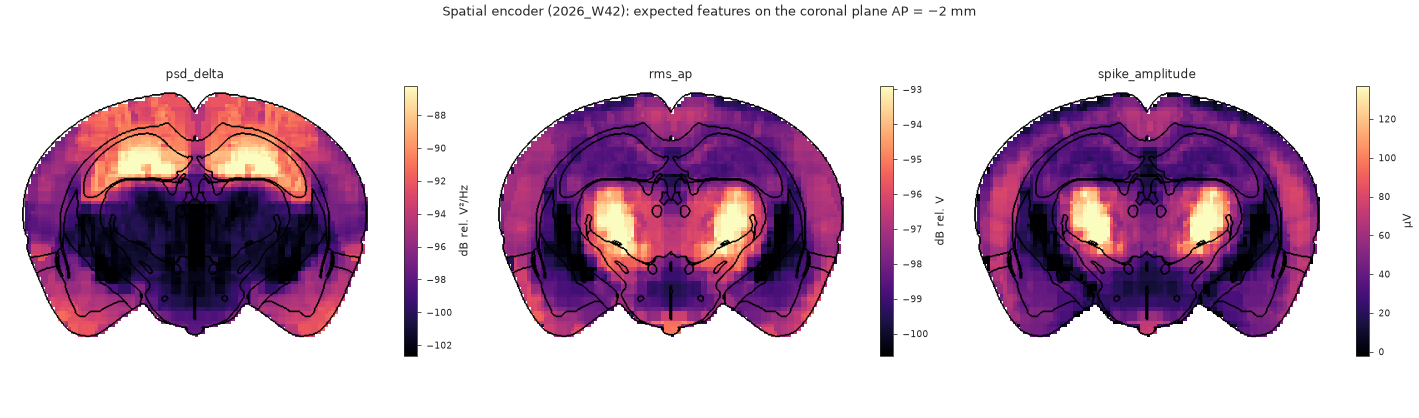
predict_xyz on the voxels of the coronal plane AP = −2 mm, every 100 µm, with the Cosmos outlines from iblatlas. Atlas maps has the code.Output is indexed exactly like the input, with one pred_<feature> column per predicted feature, in feature units. The pred_ prefix lets you join the prediction onto a table holding the ground-truth columns of the same names without a collision.
To try it with no data of your own:
sample = encoder.path_model / "example" / "features_sample.parquet"
pred = encoder.predict(pd.read_parquet(sample))
Verify the install first, as always:
encoder.selftest()
# TrueThe encoder’s self-test uses looser tolerances than the decoder’s (rtol=1e-4, atol=1e-5). These are float32 transformer outputs, which drift by around 1e-4 relative between environments with different BLAS libraries. Corrupted weights or a wrong model change the outputs by orders of magnitude more, so the tolerance still detects them.
Comparing prediction against reality
This is the main use. Join the encoder’s expectation onto your measured features and look at the residual:
df = pd.read_parquet("/data/features/aggregated/raw_ephys_features_denoised.pqt")
df_channels = pd.read_parquet("/data/features/aggregated/channels.pqt")

pred = encoder.predict(df_channels)
joined = df.join(pred)

# Residual for one feature
joined["resid_rms_lf"] = joined["rms_lf"] - joined["pred_rms_lf"]
print(joined["resid_rms_lf"].describe())
Large systematic residuals down a stretch of probe suggest the channels are not where the trajectory says they are — which is the signal an alignment workflow wants.
How it works, and what that implies
The encoder predicts from two things:
- Anatomical context — MERFISH and AGEA PCA volumes sampled at the query coordinates (50 cell PCs + 50 gene PCs, on a 200 µm voxel grid).
- Neighbouring recorded channels — real features from channels near the query position, drawn from a bank of training channels shipped with the model.
Read the neighbourhood settings straight off the manifest:
print(encoder.config["neighbourhood"])
# {'radius_um': 500.0, 'm_max': 8, 'selection': 'nearest', 'allow_same_probe': False}
As a result:
The weights alone are not a usable model. It also needs the frozen PCA context volumes and the neighbour bank, neither of which can be recomputed downstream. Both ship as artifacts:
print(encoder.index["artifacts"])
# {'weights': 'spatial_encoder.pt',
#  'context': ['agea_vol_pca.npy', 'merfish_vol_pca.npy'],
#  'confidence': 'confidence_model.pt',
#  'neighbor_bank': 'neighbor_bank.npz',
#  'stats': 'preprocessing/channel_stats.npz',
#  'split': 'split.json',
#  'results': [...]}
This is why the download is larger than the decoder’s. Each artifact has an accessor:
encoder.split()                  # {'train_pids', 'validation_pids', 'test_pids', ...}
encoder.neighbor_bank()          # {'xyz', 'feat', 'pid'}: the training channels
encoder.preprocessing_stats()    # standardisation, and the per-feature clipping thresholds
encoder.load_confidence_model()  # the probe-confidence model, in eval() mode
For 2026_W45 the split is 663 / 97 / 196 insertions, plus 93 the QC marks bad. The neighbour bank holds 254,592 training channels: positions mirrored to the left hemisphere, features clipped and standardised exactly as the model saw them.
Neighbours are drawn from other probes only (allow_same_probe: False), so a prediction for a probe already in the training bank does not use that probe’s own features.
Neighbour selection is deterministic. Training-time collation drew a random subset when more than m_max candidates fell inside the radius. Serving takes the nearest m_max, or averages such random subsets from a fixed seed (below), so predictions do not depend on the global NumPy seed. Two runs give identical numbers.
From 2026_W45 the release says how it predicts, in config.prediction of its manifest: the context interpolated between the voxels of its 200 µm grid (trilinear_context), and the mean over four random neighbour sets, as in training, from a fixed seed (neighbour_draws). On its held-out insertions this raises R² in every tissue, the root regions included, and takes about twice as long. Pass either argument to predict or predict_xyz to override it; a release without the block predicts from the nearest voxel and the nearest neighbours, as it did when it was published.
Controlling the device and batch size
encoder = load_pretrained(
    "int-brain-lab/ea-encoder-channel", revision="2026_W45", device="cuda"
)

pred = encoder.predict(df_channels, batch_size=4096)
device is forwarded to the wrapper; omit it to use the checkpoint’s own device. batch_size (default 1024) is rows per forward pass — raise it on a GPU with headroom, lower it if you run out of memory.
Troubleshooting
KeyError naming coordinate columns — the message is explicit that this model predicts features from position and needs ['x', 'y', 'z'], not the feature columns. The usual cause is passing a feature table where a channel table was wanted.
FileNotFoundError about a missing manifest — the manifest is the only record of the encoder’s neighbourhood and context settings, so a directory without one cannot be loaded.
ValueError about the feature-order digest — the manifest’s output feature list no longer matches its recorded hash. Re-download the model.
Predictions look like noise — check your coordinates are in metres, which is what the model expects.
RuntimeError: Error(s) in loading state_dict for NeighborInpaintingModel, with Missing key(s) such as qenc.pos.pe.0.weight — the release is newer than your ephysatlas. The current release was trained without the position input (use_positions: False in the manifest), which older versions cannot build. Upgrade ephysatlas.
Next steps
- Model families — how the encoder relates to the decoder and the unit encoder
- Predict unit phenotypes from position — the same question for spike-sorted units
- Predict brain regions — the inverse direction
- Plot features along the probe — visualise predicted against measured
- Atlas maps — the predictions on atlas slices, and the IBL Ephys Atlas viewer to browse them
- Which brain regions is my probe in? — the encoder at work in alignment
SpatialEncoderAPI