How to read lfpack files
Pick a recording and a scale
A file can hold several recordings (e.g. every probe of a release) and several scales of each.
from lfpack import LFPackReader

LFPackReader.recordings("multi.lf.h5")            # ['probe00', 'probe01']
LFPackReader.scales("multi.lf.h5", "probe00")     # [0]  (0 = full resolution)

sr = LFPackReader("multi.lf.h5", recording="probe00", scale=0)
recording can be omitted when the file holds a single one.
Bin channels while reading
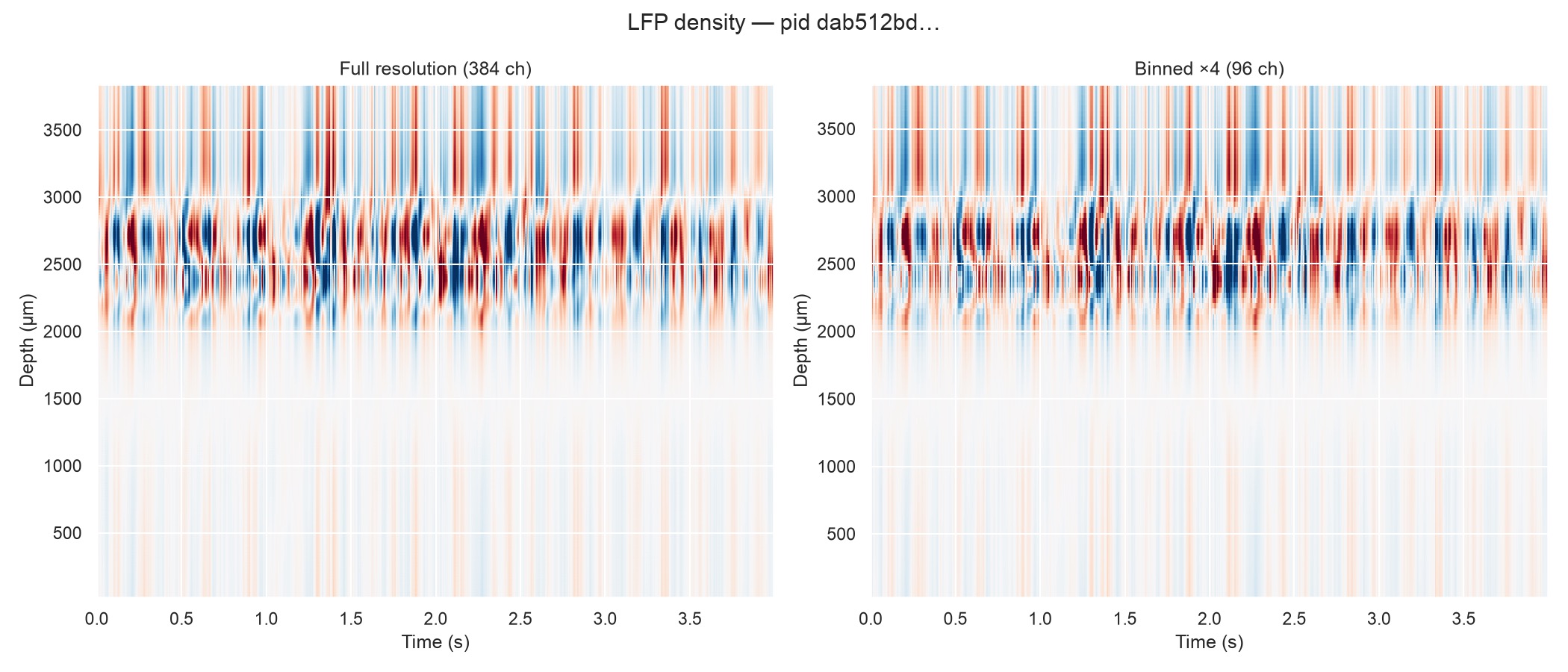
Neighbouring channels are strongly correlated at LFP frequencies. bin_channels sums groups of adjacent channels during decoding, so a brain-wide sweep never materialises 384 channels:
sr = LFPackReader("recording.lf.h5", bin_channels=4)
traces = sr[0:1000]                     # (1000, nc // 4)
sr.geometry["y"]                        # mean depth of each group
sr.geometry_full["binned_channel_index"]  # raw channel → group

sr.read_samples(0, 1000, bin_channels=8)  # per-call override
bin_channels must divide nc; sr.channels (brain locations) aggregates the same way.
Session-clock times
Use sr.times rather than np.arange(ns) / sr.fs to align samples with trial events or spikes: it applies the sync stored in the file.
Format-1 files
Files written by lfpack < 1.0 (format 1) are still read transparently. Format 1 is deprecated and will stop being readable in a future release; convert them with:
import lfpack

lfpack.upgrade_h5("old.lf.h5", "new.lf.h5")   # no re-compression; 2.4× smaller at ε = 100, α = 14