How to access the IBL Brain-Wide Map LFP dataset
The IBL Brain-Wide Map (BWM) LFP dataset is distributed as a 16GB .h5 file containing 699 individual recordings of 384 channels each.
Browse online
lfpack.internationalbrainlab.org hosts a live web viewer over the full dataset — no download or setup required. Pick a recording (searchable by pid) or filter by brain region (acronym or name, e.g. VISp or Isocortex — matching that region or any of its descendants in the Allen hierarchy), then pan/zoom the trace view and adjust gain. This is the fastest way to browse before writing any code.
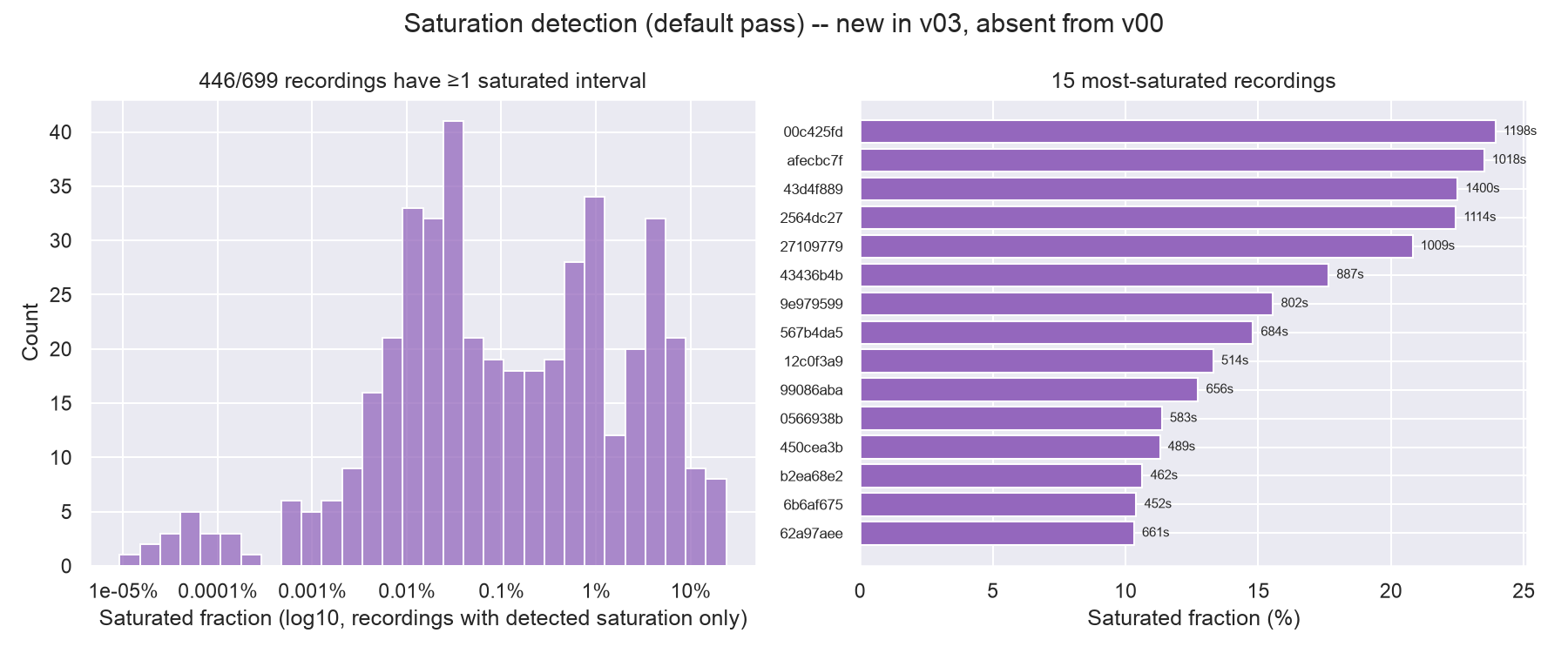
- Saturation events — ADC-clipped stretches are flagged and muted in the decompressed output; check whether your window of interest overlaps one before trusting amplitude. See Quality Control - Saturation.
- Missing sync for 7 probes —
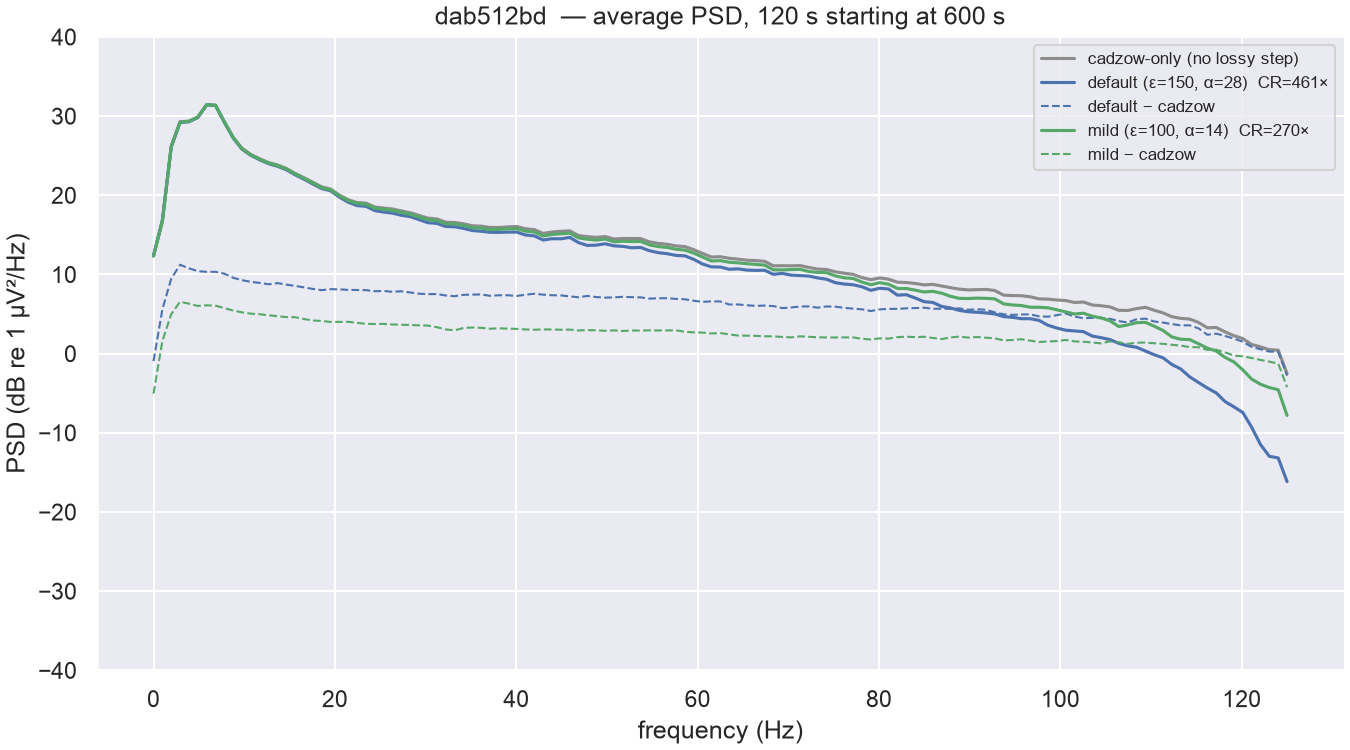
t0_sync/fs_synccould not be computed for 7 probes (spanning 4 sessions) due to a session-level sync data-quality issue upstream;sr.t0returnsNaNfor these. See lfpack#8. - High-frequency roll-off — the SVD + wavelet-packet codec trades off power above roughly 20-30 Hz for compression ratio, more so at the default tier than the mild tier. See the PSD comparison below.
- Low-frequency channel-to-channel mismatch — per-channel impedance/analog-filter differences show up as amplitude outliers at low frequencies (below 1.5 Hz) and are not fully corrected by the current pre-processing pipeline.
Align with trial events via
sr.times— each recording stores a sync-corrected session clock; always usesr.timesrather than a manualnp.arange / sr.fswhen matching LFP samples to spike times or trial events. See Session-clock times.Use binned reads for brainwide sweeps — looping over all 699 recordings at full 384-channel resolution is memory-intensive. Pass
bin_channels=4to reduce each recording to 96 spatial bins with acceptable loss of depth coverage. See Binned-channel reads.
Visualise with viewephys
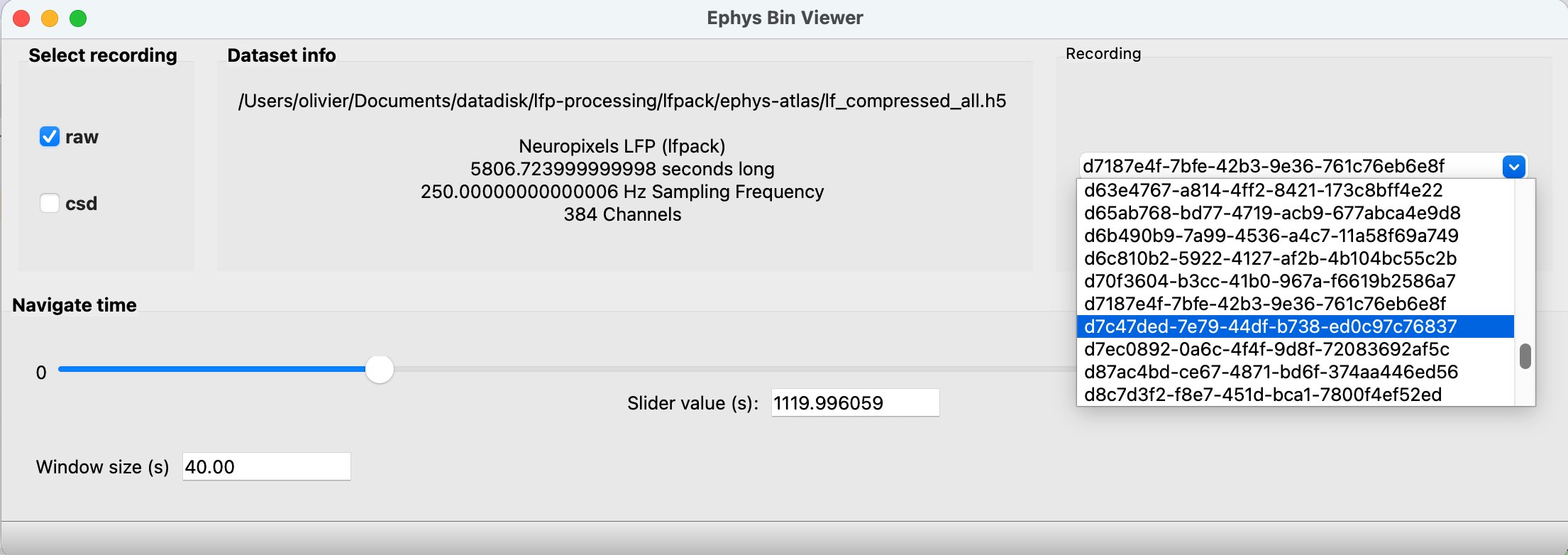
viewephys has a native lfpack backend — point it at the .h5 file directly, no manual transpose or BrainRegions wiring needed:
viewephys -f lf_compressed_all_bwm.h5The .h5 extension is auto-detected and opens the lfpack-aware viewer, which:
- shows a searchable recording selector (type any
pidsubstring) when the file holds multiple recordings, preserving window size, position and zoom when you switch - colours the depth axis by brain region automatically, reading the
atlas_id/acronymannotations embedded in the file — no separateiblatlascall required - adds a CSD (current-source density) step alongside the raw signal
The same class is usable from Python:
from viewephys.gui import LFPackBinViewer
from viewephys.viewer.qt import create_app

app = create_app()
win = LFPackBinViewer("lf_compressed_all_bwm.h5")
app.exec()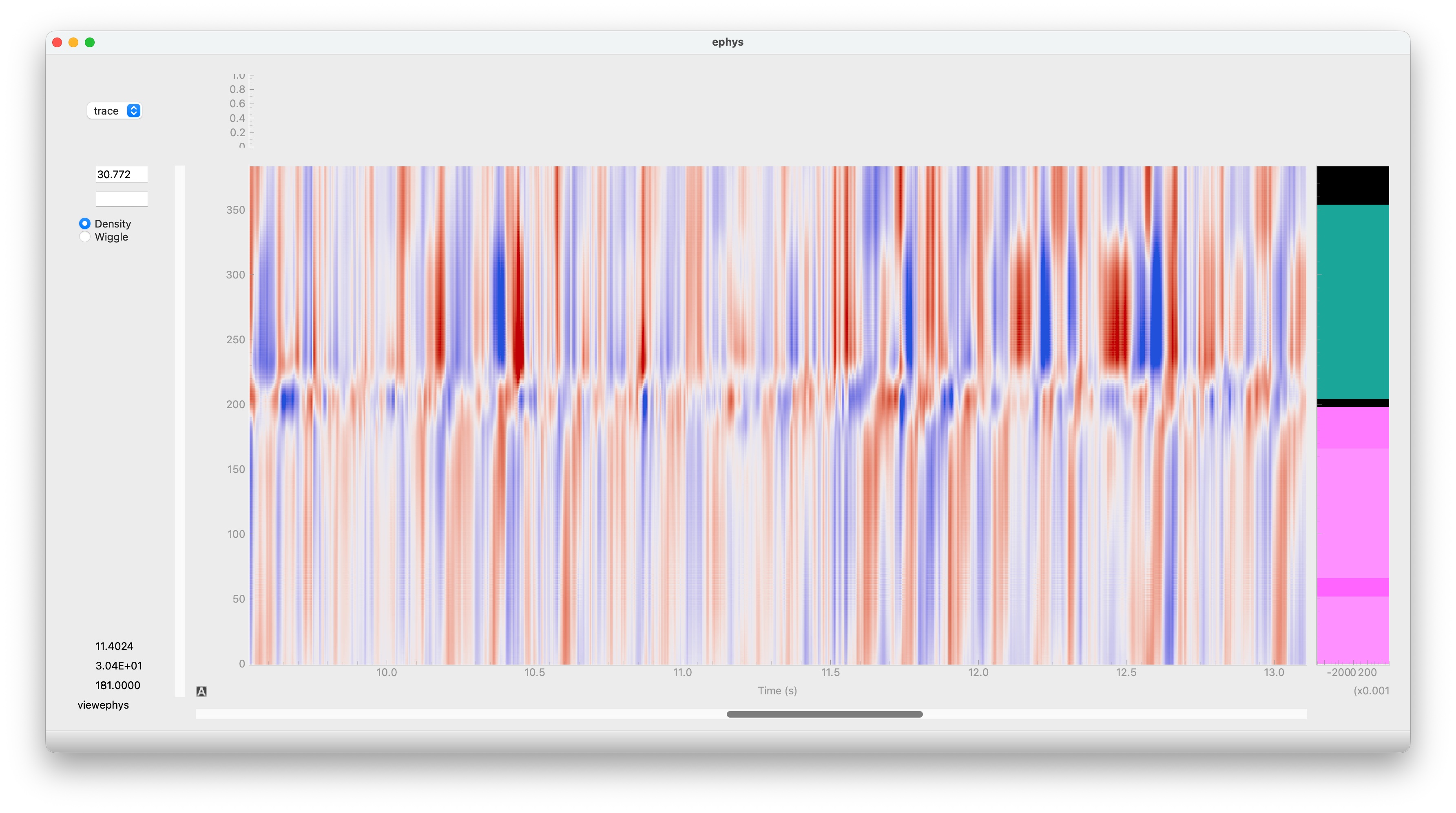
See viewephys PR #49 for implementation details.
Prerequisites
uv pip install "viewephys[lfpack]" one-apiDownload
From inside the ibl-ai-agent repository:
uv run python scripts/download_datasets.py --lfpThis downloads lf_compressed_all_bwm.h5 (~14 GB) into reports/datasets/bwm_lfp/ and writes the path into data_locations.local.yaml automatically.
Or, from Python (no AWS credentials needed — uses the ONE public S3 helper):
from one.remote.aws import s3_download_file

s3_download_file(
    source="resources/ibl-agent-data/lf_compressed_all_bwm.h5",
    destination="lf_compressed_all_bwm.h5",
)
s3_download_file defaults to the IBL public bucket, shows a tqdm progress bar, and skips the download if the local file already has the correct size.
Mild tier (higher fidelity)
A higher-fidelity mild tier (ε=100, α=14 — see Benchmark gallery) is also published for the BWM cohort, at roughly 240× rather than 430× compression. Same format, same 699 recordings — just a different accuracy/size trade-off. Not yet wired into ibl-ai-agent’s download_datasets.py --lfp flag; fetch it directly:
from one.remote.aws import s3_download_file

s3_download_file(
    source="resources/ibl-agent-data/lf_compressed_mild_all_bwm.h5",
    destination="lf_compressed_mild_all_bwm.h5",
)
Session-clock times
sr.times returns a (ns,) array of session-clock timestamps (seconds) for every LFP sample, derived from the sync signal stored during compression. Use it to align LFP traces with trial events or spike times:
from lfpack import LFPackReader
import numpy as np

file_lfpack = "lf_compressed_all_bwm.h5"
pid = 'dab512bd-a02d-4c1f-8dbc-9155a163efc0'

sr = LFPackReader(file_lfpack, recording=pid)

n = int(10 * sr.fs)
traces = sr[:n, :]      # (n_samples, nc) — first 10 s
t = sr.times[:n]        # (n_samples,)    — session-clock seconds

# Align with trial events loaded via ONE
# stim_on = trials['stimOn_times']   # already in session-clock seconds
# idx = np.searchsorted(t, stim_on)  # nearest LFP sample for each stimulus onset
List recordings
Each file contains one entry per BWM probe. Recording identifiers are named after the probe identifier UUID pid.
from lfpack import LFPackReader

recordings = LFPackReader.recordings("lf_compressed_all_bwm.h5")
print(f"{len(recordings)} recordings")
print(recordings[:3])
# 699 recordings
# ['00a824c0-e060-495f-9ebc-79c82fef4c67', '00a96dee-1e8b-44cc-9cc3-aca704d2b594', '00c425fd-ec3e-4cd2-b8af-c0bc0c4bdd44']
Read a single recording
from lfpack import LFPackReader

file_lfpack = "lf_compressed_all_bwm.h5"
pid = 'dab512bd-a02d-4c1f-8dbc-9155a163efc0'

sr = LFPackReader(file_lfpack, recording=pid)

# First 10 seconds — shape (2500, nc), float32, volts
traces = sr[: int(10 * sr.fs)].T

print(f"Duration:    {sr.ns / sr.fs:.1f} s")
print(f"Channels:    {sr.nc}")
print(f"Sample rate: {sr.fs} Hz")   # 250 Hz (decimated from 2500 Hz)
print(f"Shape:       {traces.shape}")

# Duration:    3668.9 s
# Channels:    384
# Sample rate: 250.00252518761928 Hz
# Shape:       (384, 2500)
LFPackReader is a drop-in for spikeglx.Reader. Slicing decompresses only the requested chunks — the full file is never loaded into memory.
Quality Control - Saturation
Each recording carries an insertion-level table of ADC-saturated (clipped) spans, detected on the raw LFP band before any filtering. The saturated stretches are muted (zeroed) in the decompressed output, so it’s worth checking whether a window of interest overlaps one before trusting the amplitude.
from lfpack import LFPackReader

sr = LFPackReader("lf_compressed_all_bwm.h5", recording=pid)

# Interval table: raw-rate sample indices, recording-aligned
sr.saturation
#    start_sample  stop_sample
# 0        123456       125000

# Recording-level summary (fraction/count/whether muting was applied)
sr.saturation_summary
# {'saturated_fraction': 0.0052, 'n_intervals': 3, 'total_saturated_sec': 12.9, 'muted': True, ...}
saturation_mask gives a boolean array at the reader’s own — decimated — sampling rate, indexed exactly like the reader itself rather than called with a window:
n = int(10 * sr.fs)
traces = sr[:n, :]                  # (n, nc)
mask = sr.saturation_mask[:n]       # (n,) bool, True where saturated

traces_clean = traces[~mask]
For session-clock timestamps of saturated intervals (e.g. to overlay against trial events), use saturation_times rather than converting sr.saturation’s samples to seconds by hand — it applies the same sync correction as sr.times:
sr.saturation_times()
#    start_sample  stop_sample  start_time  stop_time
# 0        123456       125000    1234.382    1235.000
All four (saturation, saturation_summary, saturation_mask, saturation_times) degrade gracefully to empty/default values on recordings without saturation detection, so the same code works across the whole dataset without a try/except.
Channel brain locations
Each recording stores per-channel brain location annotations embedded in the file — no network call needed. Access them via sr.channels:
from lfpack import LFPackReader

sr = LFPackReader("lf_compressed_all_bwm.h5", recording=pid)
ch = sr.channels

print(ch["acronym"][:5])   # ['VISp', 'VISp', 'CA1', 'CA1', 'DG']
print(ch["atlas_id"][:5])  # Allen CCF structure IDs, int32
print(ch["x"][:5])         # mediolateral MNI coordinates, metres
print(ch["y"][:5])         # anteroposterior
print(ch["z"][:5])         # dorsoventral
When using bin_channels, channels automatically aggregates: coordinates are averaged and brain region is the within-group mode:
sr = LFPackReader("lf_compressed_all_bwm.h5", recording=pid, bin_channels=4)
ch = sr.channels           # shapes (96,) — one entry per spatial bin
ch_full = sr.channels_full # shapes (384,) — always raw per-electrode
Binned-channel reads
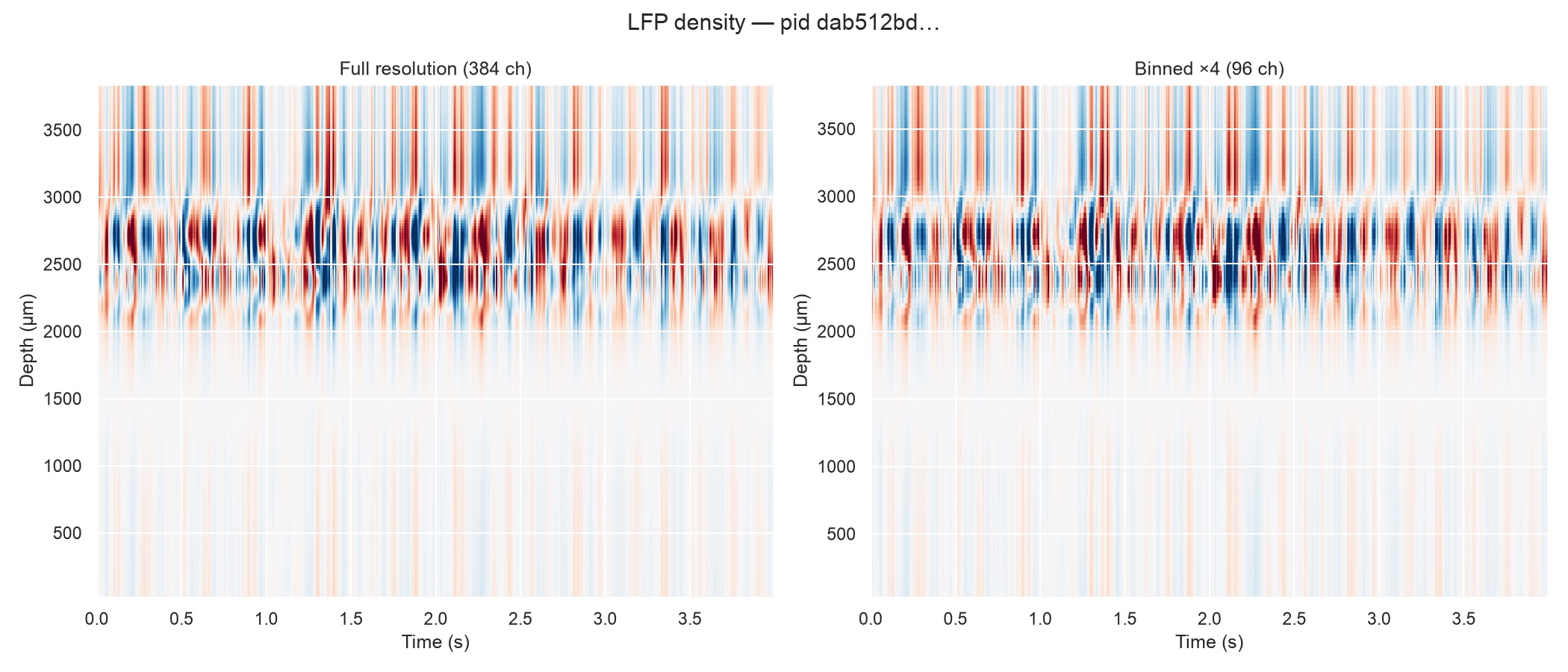
Adjacent channels are spatially correlated at LFP frequencies. Passing bin_channels sums neighbouring channels during decompression, reducing memory use. A factor of 4 takes 384 channels down to 96 while keeping depth resolution useful for LFP.
from lfpack import LFPackReader

file_lfpack = "lf_compressed_all_bwm.h5"
pid = 'dab512bd-a02d-4c1f-8dbc-9155a163efc0'

sr = LFPackReader(file_lfpack, recording=pid, bin_channels=4)

traces = sr[:, :]      # (ns, 96) — full recording, 96 spatial bins
print(sr.nc)           # 96
print(sr.geometry["y"])           # mean depth of each 4-channel group
print(sr.geometry_full['binned_channel_index'])  # spatial mapping of the original 384 channels into the 96 binned ones